

Public Policy Research Group, London, UK
Ahmed Aber, Tahir Shaaran
Abstract
Water scarcity persists in numerous regions despite decades of policy reform and formal adoption of integrated management principles. This paper argues that such persistence is frequently better explained by governance fragmentation and implementation failure than by absolute physical shortage. Drawing on comparative institutional analysis of water governance across eight countries exhibiting persistent scarcity despite formal policy commitments, we identify four interacting mechanisms through which governance failure becomes self-reinforcing: fragmented authority, weak accountability, deficient information systems, and low institutional legitimacy. We demonstrate that these mechanisms do not merely coexist but constitute a dynamically stable equilibrium which can be a governance trap resistant to piecemeal intervention. The framework explains why technocratic reforms layered onto fragmented systems routinely fail, and why crisis alone rarely produces durable governance transformation. The paper establishes the conceptual architecture for a research program examining how governance arrangements mediate between hydrological conditions and water security outcomes, and provides a diagnostic approach for identifying strategic reform entry points.
Introduction
The global water crisis is increasingly recognised as a crisis of governance rather than of absolute physical shortage [1-3]. Across regions with widely varying hydrological endowments, the gap between formal policy commitments and actual water security outcomes remains stubbornly large. Countries adopt integrated water resources management (IWRM) plans, establish basin organisations, pass progressive water legislation, and commit to international targets yet scarcity intensifies, service delivery deteriorates, and vulnerability to drought deepens [4-6].
This disjuncture between policy adoption and policy performance constitutes the central puzzle that motivates this paper. Why do apparently sensible governance reforms so often fail to produce their intended outcomes? Why does scarcity persist and in some cases worsen in contexts where technical knowledge, financial resources, and formal institutional architecture appear adequate to the challenge?
The existing literature offers valuable but partial explanations distributed across several research traditions. Institutional fragmentation scholarship documents how uncoordinated authority across sectors and jurisdictions generates policy incoherence [7-9]. Political economy analyses reveal how powerful interests benefit from weak enforcement and actively block reform implementation [10,11]. Critical governance research demonstrates that formal reforms are frequently layered onto existing institutional architectures without displacing them, creating hybrid arrangements that preserve fundamental dysfunction while appearing to address it [12,13]. Socio-ecological systems scholarship emphasises path dependency and the rigidity of established institutional configurations [14,15]. Each perspective illuminates an important dimension of the problem; none provides an integrated account of why these mechanisms co-occur, how they reinforce one another, and why they prove so resistant to reform.
This paper develops an integrative analytical framework built on the concept of governance traps. We define a governance trap as a self-reinforcing configuration of institutional mechanisms that systematically defeats reform efforts and locks a socio-hydrological system into a stable but dysfunctional equilibrium. The trap concept extends beyond standard accounts of institutional weakness by specifying the causal mechanisms through which dysfunction is maintained, the conditions under which such configurations form and persist, and the intervention logics through which they might be escaped.
Our analysis proceeds in five stages. First, we establish the analytical insufficiency of purely physical conceptions of scarcity and make the case for governance centred analysis. Second, we identify four core mechanisms fragmented authority, weak accountability, deficient information systems, and low institutional legitimacy and specify their interaction dynamics. Third, we draw on comparative evidence from eight country and basin cases to illustrate how these mechanisms combine to produce persistent scarcity outcomes. Fourth, we derive strategic principles for reform sequencing based on the trap framework. Finally, we outline the research agenda that emerges from this analysis, establishing the conceptual foundation for the program of work that subsequent papers in this series will develop.
Beyond physical scarcity: the governance mediation hypothesis
Conventional approaches to water scarcity assessment have relied predominantly on physical indicators: per capita renewable water availability, the water exploitation index, and the Falkenmark threshold, among others [16,17]. These metrics have proven valuable for large-scale comparative assessment and have informed global policy discourse, including the Sustainable Development Goal 6 monitoring framework. Their limitations, however, are increasingly well-documented [18,19].
Aggregate indicators systematically obscure the temporal and spatial dimensions of scarcity. They average across seasons, masking the acute intra-annual variability that produces drought emergencies even in basins with adequate annual supply. They neglect water quality constraints that render physically available water unusable without treatment that may be institutionally or economically inaccessible. They ignore environmental flow requirements that represent prior claims on water resources essential for ecosystem function and long-term sustainability. Most fundamentally, they fail to capture the institutional access conditions the rules, rights, infrastructure, and enforcement arrangements that determine whether water that exists physically can actually be delivered to users when and in the quality required [18,20,21].
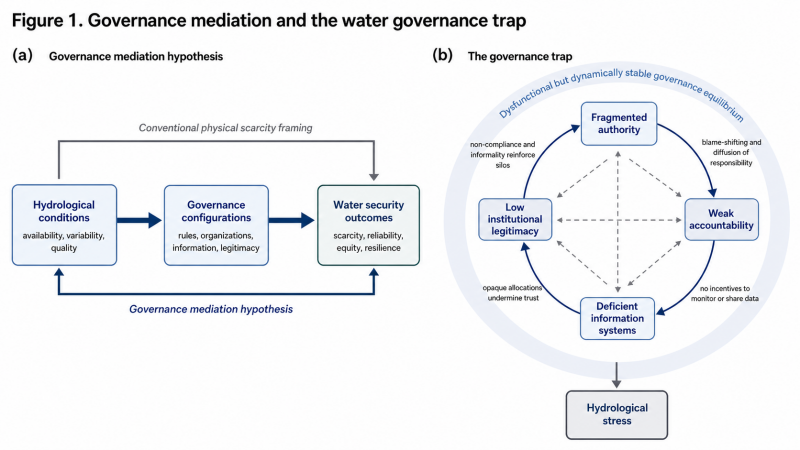
The governance mediation hypothesis posits that the relationship between hydrological conditions and water security outcomes is mediated and frequently dominated by institutional arrangements. This hypothesis generates a strong empirical prediction: two basins with identical physical endowments can exhibit radically different scarcity outcomes depending on their governance configurations. The prediction is borne out by comparative observation. Singapore, operating with per capita renewable water availability below 130 m³/year substantially below conventional scarcity thresholds achieves near-universal water security through highly integrated governance, comprehensive metering and demand management, and substantial reuse infrastructure [22]. Numerous regions with substantially higher physical availability, including parts of Central America, South Asia, and sub-Saharan Africa, experience severe lived scarcity due to governance deficits that prevent reliable service delivery, enable unchecked extraction, and preclude adaptive management [6,23].
The governance mediation hypothesis carries significant analytical implications. It suggests that diagnosing and addressing governance failure must be central to both scholarly analysis of scarcity and policy responses to it. Technical interventions desalination, recycling, efficiency improvements, storage expansion are necessary but insufficient; their effectiveness depends on the governance arrangements within which they are embedded. And it implies that governance failure is not a residual explanatory category to be invoked when other accounts prove inadequate, but a structural cause of scarcity requiring systematic theoretical and empirical treatment in its own right.
The governance trap: four mechanisms and their interactions
We identify four core mechanisms through which water governance failure becomes self-reinforcing. Each has received substantial individual attention in the scholarly literature; our contribution lies in specifying their interaction dynamics and the resulting trap configurations.
Mechanism 1: Fragmented authority
Fragmented authority characterises institutional landscapes where multiple organisations share formal responsibility for water-related decisions without clear hierarchical ordering, coordination protocols, or binding conflict resolution mechanisms. Fragmentation occurs along several dimensions: sectoral (agriculture, environment, water supply, energy, industry, mining), jurisdictional (municipal, regional, national, transboundary), and functional (allocation, quality regulation, infrastructure development, land-use planning, disaster response) [7,8,24].
The prevalence of fragmentation is empirically striking. A 2018 OECD survey of 48 countries found that the median number of national-level institutions with significant water responsibilities was eight, with formal coordination mechanisms rated as inadequate by national officials in over 60% of cases [25]. Basin-level fragmentation is frequently more acute. The Colorado River in North America is governed by an assemblage of interstate compacts, federal legislation, Supreme Court decrees, tribal water rights settlements, and binational treaty obligations that scholars have characterised as generating systematic management rigidities [26]. The Mekong Basin involves six riparian states, multiple regional institutional frameworks, and significant extra-regional actors China, multilateral development banks, private investors without a binding allocation framework [27].
Fragmentation generates scarcity through several causal pathways. It prevents coherent trade-off management because each agency optimises within its narrow mandate, producing collectively suboptimal outcomes. An agricultural ministry authorises groundwater extraction, an environmental regulator mandates minimum in-stream flows, and a municipal authority permits peri-urban development in recharge zones each decision individually defensible, collectively producing over-extraction and system degradation [9,28]. Fragmentation creates structural opportunities for blame-shifting and responsibility diffusion; when multiple authorities share responsibility, no single authority can be held accountable for aggregate outcomes [29]. And it generates prohibitive transaction costs as coordination across multiple organisations with incompatible planning cycles, data systems, and decision procedures consumes resources that might otherwise support implementation [30].
Mechanism 2: Weak accountability
Accountability denotes the extent to which decision-makers and implementing agencies face meaningful consequences for performance or its absence across dimensions of service delivery, resource stewardship, financial management, and regulatory enforcement [31]. Weak accountability prevails when mandates are vaguely specified, performance metrics are absent or politically contested, oversight institutions lack independence or investigative capacity, and affected populations lack effective channels for information access and redress [2,32].
The consequences of weak accountability for scarcity outcomes are systematic and severe. It incentivises symbolic policy adoption the promulgation of plans, strategies, and legislation that satisfy external funders or domestic political audiences without corresponding implementation investment [33]. The IWRM paradigm, formally adopted by over 80% of countries in policy documents but substantively implemented in far fewer, represents the paradigmatic case of symbolic adoption [34]. Weak accountability produces systematic investment bias toward politically visible capital projects dams, treatment plants, desalination facilities, ceremonial groundbreaking events at the expense of less visible but operationally essential functions: maintenance, metering, enforcement, groundwater monitoring, and ecosystem protection [35]. Most damagingly, weak accountability undermines the credibility of formal rules when users observe that violations are neither detected nor penalised, triggering a downward spiral of escalating non-compliance [32].
Mechanism 3: Deficient information systems
Effective water governance depends on continuous, reliable, spatially and temporally resolved information about water availability, extraction, quality, infrastructure condition, and use patterns across sectors [36]. Many governance systems, including some in high-income countries, operate with grossly inadequate information architectures. Monitoring networks are sparse or deteriorating. Data systems are incompatible across agencies. Significant extraction especially groundwater goes unmetered and unreported. Water quality parameters are monitored episodically if at all, and data that do exist are frequently inaccessible to decision-makers and the public [18,37].
The information deficit is causally significant because it enables and amplifies the other mechanisms. Without reliable data, performance cannot be evaluated, rendering accountability structurally impossible regardless of formal institutional design [36]. Information deficits undermine the perceived legitimacy of allocation decisions, which appear arbitrary or politically motivated when their empirical basis is opaque [38]. And poor information prevents adaptive learning: institutions cannot adjust strategies in response to changing conditions when outcomes are unmeasured and intervention effects unevaluated [14].
Critically, the information deficit is endogenous to governance failure. Fragmented authority reduces incentives for any single actor to invest in system-wide monitoring from which others would benefit without contributing [30]. Weak accountability means that failure to generate and share data carries no institutional consequences, removing the organisational incentive for monitoring investment [31]. The result is a low-information equilibrium that is costly to escape because the initial investment required to establish comprehensive monitoring exceeds the planning horizons and budget cycles of fragmented, weakly accountable agencies.
Mechanism 4: Low institutional legitimacy
Legitimacy refers to the perceived fairness, procedural credibility, and normative acceptability of governance arrangements by those subject to them [39]. Low legitimacy arises when rules are perceived as inequitable in design or application, decision-making processes exclude affected stakeholders or their representatives, enforcement appears arbitrary or politically selective, and outcomes are systematically uneven across social groups [40].
Legitimacy deficits contribute to scarcity primarily through compliance collapse. Formal water allocation systems depend on widespread voluntary compliance; continuous surveillance and enforcement of every extraction point, every discharge, and every use condition is administratively and financially impossible in all but the most resource-intensive governance systems [41]. When legitimacy is high, normative commitment and peer monitoring supplement formal enforcement. When legitimacy collapses, users bypass formal allocation mechanisms through unauthorised extraction, political intervention, or informal market transactions, and the governance system's coordinating capacity degrades rapidly [32,40].
The legitimacy deficit interacts with the other three mechanisms in powerfully self-reinforcing patterns. Fragmented, unaccountable, information-poor governance generates outcomes that are widely perceived as arbitrary and unfair, which progressively erodes legitimacy. Legitimacy erosion reduces the cooperation on which effective monitoring and enforcement depend, making it harder to improve information quality and demonstrate accountability. The resulting low-trust equilibrium is exceptionally stable because no single reform no new coordination body, no transparency initiative, no participatory mechanism can restore legitimacy without simultaneous improvement across accountability, transparency, and substantive fairness, a coordination challenge that fragmented systems are structurally unable to meet [39,40].
Interaction dynamics and trap formation
The four mechanisms do not simply coexist within dysfunctional governance systems; they interact causally to produce a self-reinforcing system (Figure 1). Fragmented authority weakens accountability by diffusing responsibility and obscuring causal chains between decisions and water security outcomes. Weak accountability eliminates organisational incentives to invest in monitoring systems. Information deficits prevent transparent, evidence-based allocation, undermining perceived legitimacy. Legitimacy collapse reduces compliance and cooperation, further degrading the information base as unauthorised extraction and use go unmeasured and unreported. The system stabilises at a dysfunctional equilibrium that is resistant to reform because addressing any single mechanism requires simultaneous improvements in the others improvements that the existing configuration systematically obstructs.
The trap concept advances beyond standard institutional weakness arguments in three analytically significant respects. First, it specifies the causal architecture through which dysfunction is maintained, enabling diagnostic analysis of particular configurations rather than generic "weak governance" characterisations. Second, it explains the persistent empirical failure of piecemeal reform: interventions targeting a single mechanism including a new coordination body layered onto existing fragmentation, a transparency initiative without accompanying accountability mechanisms are predictably absorbed into the existing equilibrium without disrupting its fundamental dynamics. Third, the framework generates testable hypotheses about the conditions under which traps form, persist, and might be escaped hypotheses amenable to systematic comparative empirical investigation in the research program this paper inaugurates.
Empirical evidence: comparative case analysis
To ground the framework empirically, we conducted comparative institutional analysis of water governance across eight cases exhibiting persistent scarcity despite formal policy commitments. Cases were selected to maximise variation on the hypothesised causal mechanisms and governance contexts while holding constant the presence of significant scarcity challenges and formal policy architectures. The case set includes: South Africa's Western Cape (urban drought governance), India's groundwater governance in the Indo-Gangetic Plain, Spain's Guadalquivir Basin, the Colorado River Basin (United States and Mexico), the Mekong Basin (mainland Southeast Asia), Kenya's water service delivery governance, Brazil's São Paulo metropolitan water system, and the Murray-Darling Basin (Australia).
Data sources included published institutional analyses, peer-reviewed case studies, policy and legal documents, water outcome statistics from national and international databases, and semi-structured interviews with governance actors conducted by the authors and collaborators (detailed case narratives and coding protocols in Supplementary Materials).
Each case was coded on the four trap mechanisms using a structured protocol with multiple indicators per mechanism. Two researchers coded independently; inter-coder reliability was acceptable (κ = 0.76). Disagreements were resolved through discussion and evidence review.
The analysis revealed that all eight cases exhibited moderate to severe manifestations of at least three of the four mechanisms, with strong evidence of the interaction dynamics specified in the framework.
Several patterns warrant emphasis. First, fragmentation was the most consistently severe mechanism across cases. In seven of eight cases, fragmentation was coded as High, with the Murray-Darling Basin representing a partial exception due to the Basin Plan's coordination architecture, though state-federal fragmentation remains significant. This finding is consistent with the broader institutional literature emphasising the ubiquity of fragmented water governance across political systems [7,24].
Second, information deficits were severe in five cases and moderate in three, with groundwater systems (India, Guadalquivir) exhibiting particularly acute monitoring gaps. The endo-geneity of information deficits to the broader governance failure configuration was evident: where fragmentation and weak accountability were most severe, monitoring investment was lowest, consistent with the trap framework's causal predictions.
Third, cases exhibited substantial variation in the primary causal pathways linking mechanisms to outcomes, suggesting that the trap framework captures a general phenomenon with context-specific manifestations rather than a single uniform configuration.
Reform implications: strategic entry points
If governance traps are self-reinforcing configurations resistant to piecemeal intervention, what strategic logic should guide reform efforts? The framework suggests that effective intervention requires: (1) diagnostic analysis to identify the specific trap configuration operating in a given context, and (2) sequenced reforms targeting the causal architecture of the trap rather than isolated mechanisms in isolation.
Diagnostic application
Table 2 presents diagnostic indicators corresponding to each mechanism and interaction pathway, enabling practitioners and researchers to move beyond generic "governance weakness" diagnoses toward mechanism-specific analysis. The diagnostic approach enables identification of the most severe constraints and the mechanisms through which they are maintained, informing strategic intervention prioritisation.
Sequencing logic
The framework militates against universal "best practice" reform template the approach that has characterised much international water governance promotion while providing structured guidance for context-sensitive intervention sequencing. The general sequencing principle emerging from the analysis is: information transparency first, accountability mechanisms second, mandate consolidation third, legitimacy consolidation fourth.
This sequence reflects the causal architecture of trap dynamics. Information transparency is the most feasible initial intervention because it can be pursued without immediately confronting the most powerful entrenched interests, while simultaneously enabling subsequent accountability improvements. When extraction, quality, and service data become public, it becomes politically more costly for agencies to claim ignorance and for powerful actors to extract without scrutiny. Information transparency thus creates constituencies for further reform.
Accountability mechanisms including performance indicators, independent oversight bodies, public reporting requirements become feasible once information systems generate the data on which accountability depends. Mandate consolidation, the politically most demanding reform, may only become achievable once accountability mechanisms have created pressure for coherent governance and weakened the interests that benefit from fragmentation. Legitimacy consolidation, the longest-term objective, depends on demonstrated performance across the preceding dimensions.
The sequencing logic is not rigidly deterministic. Context-specific factors crisis conditions, political leadership, civil society mobilisation, external pressure can create opportunities for more rapid reform. The Australian Millennium Drought, for example, enabled substantial mandate restructuring (the Water Act 2007 and Basin Plan) that might have been politically impossible under non-crisis conditions [42]. But the general logic provides a strategic default against which departures can be explicitly justified.
Establishing a research program
This paper establishes the conceptual foundation for a systematic program of research on water governance failure and reform. The governance trap framework generates testable hypotheses, identifies diagnostic tools, and suggests strategic intervention principles. But it also opens numerous questions requiring further investigation questions that subsequent papers in this series will address.
Several priorities are immediately apparent. The equity dimensions of governance failure require systematic treatment: how do governance traps distribute scarcity unevenly across social groups, and what policy interventions can protect vulnerable populations while broader governance reform proceeds? The urban dimension of governance failure, particularly the phenomenon of intermittent water supply as a manifestation of hidden scarcity, demands focused analysis. The role of specific policy instruments demand management, reuse, storage, aquifer recharge within the broader governance context requires evaluation. The data and monitoring deficits identified as central to trap dynamics warrant dedicated investigation. And the multi-level and transboundary governance challenges that compound fragmentation require analysis at appropriate scale.
Conclusion
Water scarcity persists in many regions not primarily because of absolute physical shortage, but because governance systems systematically fail to translate policy commitments into water security outcomes. Fragmented authority, weak accountability, deficient information, and low legitimacy interact in self-reinforcing configurations governance traps that defeat piecemeal reform and convert manageable hydrological stress into chronic, inequitably distributed scarcity.
The governance trap framework developed in this paper provides a diagnostic language for identifying the specific institutional pathologies operating in particular contexts and a strategic logic for designing interventions capable of disrupting self-reinforcing cycles of failure. It suggests that reform sequencing matters decisively, that information transparency represents the most generalisable initial intervention, and that mandate consolidation must be matched to political context and institutional capacity.
References
[1] Pahl-Wostl, C. (2015). Water Governance in the Face of Global Change. Springer.
[2] OECD. (2015). OECD Principles on Water Governance. OECD Publishing.
[3] Gupta, J., et al. (2013). The water governance challenge. Current Opinion in Environmental Sustainability, 5(6), 573-579.
[4] Woodhouse, P., & Muller, M. (2017). Water governance—An historical perspective on current debates. World Development, 92, 225-241.
[5] Pahl-Wostl, C., et al. (2012). From applying panaceas to mastering complexity. Environmental Science & Policy, 23, 24-34.
[6] Damkjaer, S., & Taylor, R. (2017). The measurement of water scarcity: Defining a meaningful indicator. Ambio, 46, 513-531.
[7] Lubell, M., & Edelenbos, J. (2013). IWRM: A comparative analysis of policy networks. Ecology and Society, 18(3), 49.
[8] Pahl-Wostl, C., & Knieper, C. (2014). The capacity of water governance to deal with climate adaptation. Global Environmental Change, 29, 68-77.
[9] Moss, T. (2012). Spatial fit, from panacea to practice. Ecology and Society, 17(3), 2.
[10] Swyngedouw, E. (2009). The political economy and political ecology of the hydro-social cycle. Journal of Contemporary Water Research & Education, 142, 56-60.
[11] Shah, T. (2014). Groundwater governance and irrigated agriculture. GWP Technical Committee Background Paper No. 19.
[12] Thelen, K. (2004). How Institutions Evolve. Cambridge University Press.
[13] Huitema, D., et al. (2009). Adaptive water governance. Ecology and Society, 14(1), 26.
[14] Gunderson, L. H., & Holling, C. S. (2002). Panarchy. Island Press.
[15] Marshall, G. R., & Alexandra, J. (2016). Institutional path dependence in the Murray-Darling Basin. Water Alternatives, 9(3), 679-703.
[16] Falkenmark, M. (1989). The massive water scarcity now threatening Africa. Ambio, 18(2), 112-118.
[17] Rijsberman, F. R. (2006). Water scarcity: Fact or fiction? Agricultural Water Management, 80(1-3), 5-22.
[18] Liu, J., et al. (2017). Water scarcity assessments in the past, present, and future. Earth's Future, 5(6), 545-559.
[19] Van Loon, A. F., et al. (2016). Drought in the Anthropocene. Nature Geoscience, 9, 89-91.
[20] Hoekstra, A. Y., & Mekonnen, M. M. (2012). The water footprint of humanity. PNAS, 109(9), 3232-3237.
[21] Boulay, A. M., et al. (2018). WULCA consensus model for water scarcity footprints. International Journal of Life Cycle Assessment, 23, 368-378.
[22] Tortajada, C., et al. (2013). Water Management in Singapore. Routledge.
[23] Damkjaer, S., & Taylor, R. (2017). The measurement of water scarcity. Ambio, 46, 513-531.
[24] Bakker, K., & Cook, C. (2011). Water governance in Canada. International Journal of Water Resources Development, 27(2), 275-289.
[25] OECD. (2018). Implementing the OECD Principles on Water Governance. OECD Publishing.
[26] Adler, R. W. (2012). Restoring Colorado River Ecosystems. Island Press.
[27] Grumbine, R. E., et al. (2012). Mekong hydropower: Drivers of change. Frontiers in Ecology and the Environment, 10(2), 91-98.
[28] Moss, T. (2012). Spatial fit in EU Water Framework Directive implementation. Ecology and Society, 17(3), 2.
[29] Peters, B. G. (2015). Pursuing Horizontal Management. University Press of Kansas.
[30] Feiock, R. C. (2013). The institutional collective action framework. Policy Studies Journal, 41(3), 397-425.
[31] Bovens, M. (2007). Analysing and assessing accountability. European Law Journal, 13(4), 447-468.
[32] Sultana, F., & Loftus, A. (2012). The Right to Water. Earthscan.
[33] Dimitrov, R. S. (2016). The Paris Agreement on climate change. Global Environmental Politics, 16(3), 1-11.
[34] UN-Water. (2018). SDG 6 Synthesis Report 2018 on Water and Sanitation. United Nations.
[35] Flyvbjerg, B. (2014). What you should know about megaprojects. Project Management Journal, 45(2), 6-19.
[36] Timmerman, J. G., et al. (2017). Information Needs for Water Management. CRC Press.
[37] Gleeson, T., et al. (2020). Global groundwater sustainability. Annual Review of Earth and Planetary Sciences, 48, 431-463.
[38] Molle, F., & Closas, A. (2020). Why is groundwater governance in arrested development? Water International, 45(1), 1-24.
[39] Suchman, M. C. (1995). Managing legitimacy. Academy of Management Review, 20(3), 571-610.
[40] Boelens, R., et al. (2016). Hydrosocial territories. Water International, 41(1), 1-14.
[41] Ostrom, E. (1990). Governing the Commons. Cambridge University Press.
[42] Connell, D., & Grafton, R. Q. (2011). Water reform in the Murray-Darling Basin. Water Resources Research, 47, W00G03.

Add comment
Comments