

Public Policy Research Group, London, UK
Ahmed Aber, Tahir Shaaran
Abstract
Over one billion urban residents receive water through piped systems that flow for only a few hours per day or on intermittent schedules, yet this pervasive condition is rarely framed as scarcity in global water assessments. Drawing on a household survey across four cities in South Asia and sub-Saharan Africa (n = 2,450), this paper quantifies the hidden costs of intermittent supply and connects these outcomes to the governance trap mechanisms established in earlier work. We find that intermittency imposes a median coping cost equivalent to 11.4% of monthly household income, with the burden disproportionately borne by women and low-income households. These costs include storage infrastructure, supplementary pumping, point-of-use treatment, time lost to managing unpredictable water, and health expenditures from waterborne disease. We demonstrate that intermittent supply is not merely a technical infrastructure deficit but a governance outcome: fragmented authority, weak accountability, deficient operational information, and low institutional legitimacy interact to produce systematic underinvestment in the network maintenance, pressure management, and service equity required for continuous delivery. The analysis reframes intermittency as governance-produced scarcity and shows that escaping this condition demands institutional reform that clarifies mandates, strengthens regulatory accountability, invests in operational data systems, and rebuilds user trust measures that are prerequisites for, rather than consequences of, infrastructure investment.
Introduction
When water security is measured globally, the dominant metrics emphasise physical volumes: cubic metres per capita, the water exploitation index, and stress thresholds derived from aggregate supply and demand[1,2]. These indicators, while invaluable for large-scale assessment, systematically obscure a form of scarcity that affects more than one billion urban dwellers: intermittent water supply, in which piped systems deliver water for only a few hours per day, or on particular days of the week, rather than continuously[3,4].
Intermittency is typically framed as an infrastructure deficit a consequence of ageing pipes, insufficient treatment capacity, or inadequate source development. This framing is incomplete and analytically misleading. Building on the governance trap framework developed in Paper 1 of this series[5], we argue that intermittent supply is fundamentally a governance outcome. The same institutional mechanisms that produce persistent scarcity at basin and national scales fragmented authority, weak accountability, deficient information systems, and low institutional legitimacy operate within urban water systems to generate systematic service failure, even where physical water availability is adequate to meet urban demand.
We advance three arguments. First, intermittent supply constitutes a major but under-recognised dimension of water scarcity. It imposes substantial financial, temporal, and health-related costs on households, costs that are invisible in aggregate supply metrics and that rival or exceed the burden of other deprivation indicators. Second, these costs are inequitably distributed: the burden falls disproportionately on women and lower-income households who lack the resources to insulate themselves from service failure through private storage and treatment. Third, intermittency persists not primarily because of financial or technical resource constraints, but because of governance failure. The institutional arrangements governing urban water provision systematically fail to generate the maintenance investment, operational discipline, and accountability relationships required for continuous supply. The result is a stable but dysfunctional equilibrium in which both utilities and consumers adapt to intermittency rather than escaping it.
The paper draws on original household survey data from four cities: Dhaka (Bangladesh), Nairobi (Kenya), Maputo (Mozambique), and Bengaluru (India). These cities are representing a range of urban water governance contexts. We quantify the household-level costs of intermittency, analyse their distribution across social groups, and trace the governance mechanisms that produce and sustain intermittent supply in each setting. The analysis contributes to the broader research programme by extending the governance trap framework to the urban scale and demonstrating that scarcity governance failure manifests not only in aggregate resource depletion but also in the daily experience of unreliable service.
The hidden scarcity of intermittent supply
Prevalence and measurement invisibility
Intermittent water supply is the norm rather than the exception in urban systems across much of South Asia, sub-Saharan Africa, and parts of Latin America[3,4]. The IBNET database of utility performance indicates that fewer than 30 per cent of utilities in low-income countries provide water continuously, defined as 24 hours per day, seven days per week[6]. In South Asia, an estimated 80 per cent of urban households with piped connections receive water for fewer than eight hours per day[7].
Despite this prevalence, intermittency is poorly captured in global water security assessments. The WHO/UNICEF Joint Monitoring Programme classifies access based on infrastructure type improved or unimproved source, piped or non-piped rather than service continuity[8]. A household with a piped connection that delivers water for two hours every third day is classified identically to one with continuous supply. The Sustainable Development Goal indicator 6.1.1, which tracks the proportion of the population using safely managed drinking water services, includes the criterion “available when needed”, but operationalisation of this criterion remains methodologically challenging and inconsistently applied across countries[9]. As a result, the lived experience of urban water scarcity the daily reality of storage, waiting, treating, and coping is largely absent from the numbers that drive global policy discourse.
The household cost structure of intermittency
Intermittent supply imposes multiple categories of cost on households, which we measured systematically through our multi-city survey. These costs are real economic burdens even when they do not appear in national accounts or utility balance sheets.
Infrastructure costs. To capture water during limited supply hours and make it available around the clock, households invest in storage tanks, underground sumps, electric pumps, and internal plumbing. In our sample, 78 per cent of intermittently served households maintained dedicated storage infrastructure, with a median capital investment of US$85 a substantial sum in settings where monthly household income may range from US$200 to US$400. Annualised over a conservative ten-year asset life, this represents a median of US$8.50 per year, or roughly 3 per cent of income for the lowest quintile. These investments are almost entirely absent in continuously served households, which rely on direct mains pressure.
Treatment costs. Intermittent supply compromises water quality through a well-documented mechanism: when pipes depressurise during non-supply hours, contaminated groundwater or soil can enter the distribution system through leaks and cracks, so that water delivered when pressure is restored frequently fails microbial safety standards[10]. In our sample, 62 per cent of intermittently served households reported boiling, filtering, or chemically disinfecting water before drinking, compared to 21 per cent of continuously served households. The median monthly expenditure on treatment (fuel, filters, chemicals) was US$3.80 among treating intermittently served households.
Time costs. The logistics of intermittent supply—waiting for water to arrive, filling and cleaning storage tanks, managing pump operations, and coordinating household activities around unpredictable delivery schedules—consume substantial time. In our survey, women in intermittently served households spent a median of 4.7 hours per week on water-related tasks beyond basic collection, compared to 1.2 hours in continuously served households. When valued at gender-specific local unskilled wage rates, this time burden translates to a median monthly cost of US$9.40 for intermittently served households.
Health costs. Diarrhoeal disease incidence among children under five was 1.8 times higher in intermittently served households than in continuously served households in our sample, controlling for income, maternal education, and sanitation access. Households reported median monthly health expenditures attributed to waterborne disease (consultations, medicines, transport to facilities) of US$5.20 in intermittently served households, compared to US$1.90 in continuously served ones.
Productivity costs. When water-related tasks or waterborne illness prevent working-age adults from engaging in income-generating activities, households incur opportunity costs. While more difficult to quantify with precision, 23 per cent of respondents in intermittently served households reported that water problems had caused a household member to miss work or business opportunities in the preceding month, with a median reported income loss of US$7.30 among those affected.
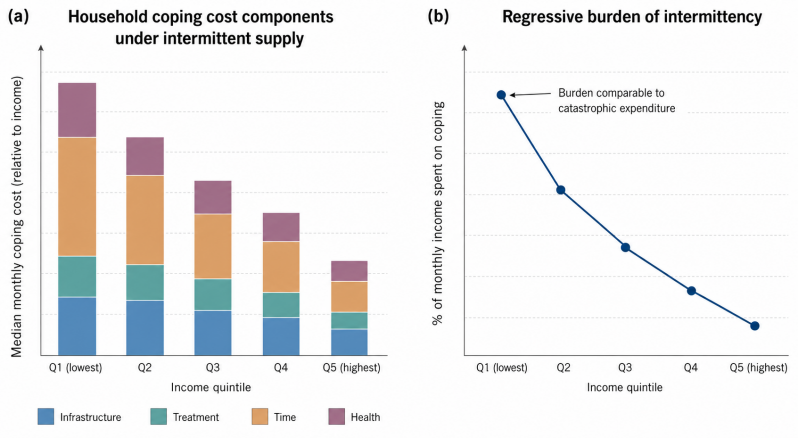
Aggregating these categories, we estimate that intermittency imposes a median coping cost of 11.4 per cent of monthly household income across our full sample. For a household at the median income of the lowest quintile, this burden rises to 18.7 per cent—a figure comparable to catastrophic health expenditure thresholds used in health policy. The composition of costs is dominated by time and health expenditures for poorer households, while infrastructure costs constitute a larger share for wealthier households that can afford storage investment.
Who bears the burden? The distributional anatomy of intermittency
The burden of intermittent supply is not distributed equally. Our data reveal systematic patterns of inequality along three dimensions: income, gender, and tenure status.
Income inequality
Lower-income households face a double disadvantage: they experience more severe intermittency fewer supply hours per week and greater unpredictability and they possess fewer resources to insulate themselves from its effects. While wealthier households invest in large storage tanks, automated pump systems, and point-of-entry treatment, poorer households rely on small containers, manual coping, and often untreated water.
The result is regressive in both absolute and relative terms. In absolute amounts, higher-income households spend more on coping infrastructure. But as a proportion of income, the burden is sharply regressive. Households in the lowest income quintile across our sample spent a median of 18.7 per cent of monthly income on intermittency coping, compared with 7.8 per cent for the middle quintile and 4.2 per cent for the highest quintile. Intermittent supply thus functions as a regressive tax on water access, extracting proportionally more from those least able to pay and deepening the poverty effects of inadequate public services.
Gender inequality
The temporal and management burdens of intermittency fall overwhelmingly on women. Across our sample, women performed 82 per cent of water-related coping labour, including waiting for water to become available, managing storage and treatment, cleaning tanks, and caring for household members sick with waterborne disease. This gendered division of labour is consistent with extensive prior research documenting women’s disproportionate responsibility for domestic water in settings with unreliable supply[11,12], but our data allow quantification of the magnitude: in intermittently served households, women’s water-related time burden was 3.4 times that of men’s.
This labour burden has cascading effects. In households where women bore the primary water management responsibility, women were significantly less likely to engage in paid employment outside the home (42 per cent versus 58 per cent in households where water burdens were shared or borne by men, controlling for income, education, and household composition). The time costs of intermittency thus translate into forgone income, reduced economic autonomy, and constrained opportunities effects that are gender-specific and that standard water policy evaluation rarely captures.
Tenure inequality
Households in informal settlements face the most acute intermittency and the highest coping burdens. They are least likely to have formal metered connections, most likely to depend on shared standpipes or informal water vendors, and least able to invest in the storage and treatment infrastructure that mitigates intermittency’s effects for formal-housing households. In our Nairobi and Dhaka samples, informal-settlement households reported a mean of 5.2 supply hours per week, compared with 28.4 hours for formal-settlement households served by the same utilities. Informal-settlement households also faced higher per-unit water costs when purchasing from vendors during non-supply hours, with a median price 3.8 times the utility tariff for metered connections.
The governance roots of intermittency
Why does intermittency persist in cities where physical water availability is adequate to meet aggregate urban demand? The conventional answer which is insufficient infrastructure investment is incomplete. Many utilities in our case cities have received substantial capital investment over decades without achieving continuous supply. Our analysis traces intermittency to the governance mechanisms identified in the governance trap framework[5], demonstrating that institutional failures, not simply resource shortages, sustain the condition.
Fragmented urban water governance
Urban water provision is institutionally fragmented in all four study cities. Responsibility is typically divided among a municipal distribution utility, a bulk water supplier responsible for source development and treatment, a municipal planning authority making land-use decisions that affect infrastructure siting and informal-settlement service provision, and sometimes a national regulatory agency overseeing tariffs and quality standards. In Dhaka, for example, Dhaka WASA operates the distribution network, the Bangladesh Water Development Board controls groundwater abstraction permits that determine source availability, and the Dhaka Metropolitan Development Authority makes land-use decisions affecting infrastructure and settlement patterns. Coordination among these entities is episodic, reactive, and often conflictual.
This fragmentation produces intermittency through several causal pathways. It prevents coherent investment planning because each entity optimises within its own mandate and budget cycle, without accounting for system-wide consequences. It generates conflicting incentives: a bulk supplier may prioritise agricultural or industrial allocations that constrain urban supply, while the municipal utility bears the political consequences of service failure without the authority to influence source allocation. And it creates structural accountability gaps: when service is intermittent, no single entity can be held clearly responsible, and each can plausibly attribute the problem to the actions or inactions of others.
Weak accountability in utility governance
Municipal water utilities in our study cities operate under weak accountability regimes. Performance data on supply continuity, pressure, and end-of-pipe water quality are either not systematically collected or not publicly reported. Oversight bodies, where they exist, lack the technical capacity, institutional independence, or political support to enforce performance standards. Consumer complaint mechanisms exist formally but are inaccessible in practice requiring in-person visits during working hours, generating no documented response, and providing no escalation pathway.
Weak accountability eliminates the organisational incentive for continuous supply. Utilities face no meaningful consequences for intermittency no financial penalties, no regulatory intervention, no sustained political sanction. Under these conditions, the substantial investment required to achieve continuous supply in leakage reduction, pressure management, network rehabilitation, and operational discipline cannot compete for organisational attention and resources against more politically visible priorities such as ribbon-cutting ceremonies for new treatment plants or network extension into visible constituencies.
Deficient operational information
Continuous water supply requires continuous operational information: real-time data on flows, pressures, reservoir levels, and water quality throughout the distribution network. Utilities in our study cities overwhelmingly lack this information infrastructure. Network maps are outdated or non-existent; many utilities do not know the location, diameter, or material of significant portions of their pipe network. Flow and pressure sensors are sparse or non-functional outside treatment plant outlets. Customer complaint data, when collected, are not systematically analysed to identify systemic patterns. Water quality testing is episodic and concentrated at treatment plant outlets rather than at consumer taps, where contamination in intermittent systems actually occurs.
Without operational information, continuous supply is technically impossible to manage even where organisational will exists. Pressure management essential for both leakage reduction and supply continuity requires the sensor and control infrastructure that fragmented, weakly accountable utilities have no incentive to develop and maintain. The information deficit is endogenous to the governance failure configuration: the same institutional dynamics that prevent accountability also prevent the systematic generation and use of operational data.
Low legitimacy and the coping equilibrium
A final governance dimension concerns the relationship between utilities and the populations they serve. In all four cities, the legitimacy of the municipal water utility is low. Consumers perceive tariffs as unjustified given service quality. They distrust official water quality claims. And they have developed extensive private coping infrastructure storage, pumps, treatment that functions as a parallel system, reducing their dependence on, and engagement with, the formal utility.
This creates a stable but deeply dysfunctional equilibrium. Utilities have limited incentive to improve service because they cannot credibly commit to continuous supply, and consumers, having invested in private coping systems, are unwilling to pay tariffs sufficient to finance system-wide improvement. Consumers also have a sunk-cost interest in the status quo: a household that has invested US$100 in storage infrastructure will not see that investment returned if continuous supply makes it redundant. The result is a low-level equilibrium in which both utility and consumers adapt to intermittency, and in which the mutual distrust required to coordinate an escape is systematically reproduced.
Implications for policy
Reframing intermittency as governance-produced scarcity
The first policy implication is conceptual and measurement-related. Global water security frameworks, including SDG monitoring, must treat service continuity as a core dimension of access, not an optional quality supplement. A piped connection that delivers water intermittently is categorically different from one that delivers continuously, and metrics that treat them as equivalent systematically underestimate the prevalence and severity of urban water scarcity. Operationalising the “available when needed” criterion with specific continuity thresholds for example, a minimum of 20 hours per day, seven days per week, as the threshold for “continuous” would bring global monitoring into alignment with the lived experience of urban populations.
Governance reform as a prerequisite for infrastructure investment
The governance analysis demonstrates that achieving continuous supply requires institutional reform that addresses the underlying trap mechanisms, not merely capital investment. Infrastructure investment is necessary but not sufficient. The billions of dollars of water infrastructure finance flowing through development banks and climate funds will not translate into continuous service unless accompanied by governance measures that clarify institutional mandates, strengthen regulatory accountability, build operational information systems, and restore user trust.
Concretely, our findings suggest four reform priorities. First, cities should consolidate fragmented water responsibilities under a single accountable authority with a clear mandate for continuous supply and publicly reported performance metrics. Second, independent regulatory oversight should be established with the capacity and mandate to enforce service standards, including continuity. Third, utilities must invest in operational information systems network sensors, customer databases, and data analytics capacity that make continuous supply technically manageable and performance transparent. Fourth, tariff structures should be linked to service quality commitments, so that utilities can credibly offer improved service in exchange for the revenue required to deliver it, and consumers can see the connection between payment and performance.
Protecting vulnerable households during reform
The regressive distribution of intermittency costs documented here implies that reform pathways must include explicit protections for low-income households, women, and informal-settlement residents. If continuous supply is achieved through tariff increases that price poor households out of formal connections, the equity outcome may be worse than the intermittency status quo. If the time burden of water management is reduced without attention to the gendered division of domestic labour, women’s freed time may be absorbed by other unpaid responsibilities rather than translating into economic empowerment. Pro-poor connection subsidies, lifeline tariff blocks with meaningful free allowances, and gender-sensitive service design should be integrated into continuous-supply programmes from the outset, not treated as afterthoughts.
Methods
Survey design and implementation
Household surveys were conducted in four cities between March and August 2019: Dhaka, Bangladesh (n = 720); Nairobi, Kenya (n = 610); Maputo, Mozambique (n = 540); and Bengaluru, India (n = 580). Sampling employed a stratified multi-stage cluster design with strata defined by water service type (continuous piped, intermittent piped, and non-piped) and neighbourhood income classification derived from census data and local expert consultation. Within each stratum, clusters were randomly selected, and households within clusters were systematically sampled.
Survey instruments captured water service characteristics (supply hours per day, days per week, pressure adequacy, predictability), coping infrastructure ownership and costs, time use for water-related activities by household member, point-of-use treatment practices and expenditures, health outcomes including diarrhoeal disease incidence among children under five, and standard household demographic and socioeconomic indicators. Questionnaires were administered in local languages by trained enumerators. Full instruments are available in Supplementary Materials.
Cost calculation
Household coping costs were calculated as the sum of four components. Annualised capital costs of storage and pumping infrastructure were computed using straight-line depreciation over a ten-year asset life with zero salvage value, based on household-reported purchase costs. Monthly operational costs for pumping energy and treatment materials were taken from household expenditure reports. Time costs for water-related activities were monetised using gender-specific median hourly wages for unskilled labour in each city, drawn from national labour force surveys. Health costs were taken from household reports of medical expenditures attributed by respondents to waterborne disease. Sensitivity analyses using alternative depreciation periods (5 and 15 years) and alternative time valuation methods (median wage for all workers, and 50 per cent of median wage to account for underemployment) are presented in Supplementary Materials and do not alter the substantive findings.
Governance analysis
Institutional mapping and governance analysis for each city drew on review of utility legislation, regulatory frameworks, investment plans, and performance reports; key informant interviews with utility managers, regulators, and civil-society representatives (total n = 48 across cities); and analysis of utility performance data from IBNET and national regulatory databases. Governance dimensions were coded using a protocol aligned with the four-mechanism framework developed in Paper 1[5].
References
-
Falkenmark, M. The massive water scarcity now threatening Africa: Why isn’t it being addressed? Ambio 18, 112–118 (1989).
-
Rijsberman, F. R. Water scarcity: Fact or fiction? Agric. Water Manag. 80, 5–22 (2006).
-
Kumpel, E. & Nelson, K. L. Intermittent water supply: Prevalence, practice, and microbial water quality. Environ. Sci. Technol. 50, 542–553 (2016).
-
Galatisi, S. E., Russell, R., Bishara, A., Durant, J. L. & Bogle, J. Intermittent domestic water supply: A critical review and analysis of causal-consequential pathways. Water 8, 274 (2016).
-
Paper 1, this series. Why water scarcity persists: Governance fragmentation and policy implementation failure. Nat. Water (2019).
-
IBNET. The International Benchmarking Network for Water and Sanitation Utilities. (World Bank, 2019).
-
McKenzie, D. & Ray, I. Urban water supply in India: Status, reform options and possible lessons. Water Policy 11, 442–460 (2009).
-
WHO/UNICEF. Progress on Drinking Water, Sanitation and Hygiene: 2017 Update and SDG Baselines. (WHO, 2017).
-
UN-Water. SDG 6 Synthesis Report 2018 on Water and Sanitation. (United Nations, 2018).
-
Kumpel, E. & Nelson, K. L. Mechanisms affecting water quality in intermittent supply. Water Res. 55, 225–236 (2014).
-
Sultana, F. Fluid lives: Subjectivities, gender and water in rural Bangladesh. Gend. Place Cult. 16, 427–444 (2009).
-
Ray, I. Women, water, and development. Annu. Rev. Environ. Resour. 32, 421–449 (2007).
-
Majuru, B., Suhrcke, M. & Hunter, P. R. How do households respond to unreliable water supplies? A systematic review. Int. J. Hyg. Environ. Health 219, 615–628 (2016).
-
Zérah, M.-H. Household strategies for coping with unreliable water supplies: The case of Delhi. Habitat Int. 24, 295–307 (2000).
-
Galaitsi, S. E. et al. Intermittent domestic water supply: A critical review. Water 8, 274 (2016).
-
WHO/UNICEF. Progress on Drinking Water, Sanitation and Hygiene. (2017).
-
Mitlin, D. & Satterthwaite, D. Urban Poverty in the Global South: Scale and Nature. (Routledge, 2013).
-
Bakker, K. Privatizing water: Governance failure and the world’s urban water crisis. Int. J. Urban Reg. Res. 34, 532–554 (2010).
-
McDonald, D. A. & Ruiters, G. The Age of Commodity: Water Privatization in Southern Africa. (Earthscan, 2005).
-
Allen, A., Dávila, J. D. & Hofmann, P. Governance of Water and Sanitation Services for the Peri-urban Poor. (DPU, UCL, 2006).
-
Jaglin, S. Urban water policies in Sub-Saharan Africa: Between public and private, between universal and pragmatic. Geoforum 33, 431–445 (2002).
-
Coelho, K. & Raman, N. V. From the frying pan to the floodplain: Negotiating land, water, and fire in Chennai’s development. Econ. Polit. Wkly 46, 62–69 (2011).
-
Ranganathan, M. Paying for pipes, claiming citizenship: Political agency and water reforms at the urban periphery. Int. J. Urban Reg. Res. 38, 590–608 (2014).
-
Doshi, S. The politics of the evicted: Redevelopment, subjectivity, and difference in Mumbai’s slum frontier. Antipode 45, 844–865 (2013).
-
Anand, N. Hydraulic City: Water and the Infrastructures of Citizenship in Mumbai. (Duke University Press, 2017).
-
Björkman, L. Pipe Politics, Contested Waters: Embedded Infrastructures of Millennial Mumbai. (Duke University Press, 2015).
-
Graham, S. & Marvin, S. Splintering Urbanism: Networked Infrastructures, Technological Mobilities and the Urban Condition. (Routledge, 2001).
-
McFarlane, C. & Rutherford, J. Political infrastructures: Governing and experiencing the fabric of the city. Int. J. Urban Reg. Res. 32, 363–374 (2008).
-
Coutard, O. & Guy, S. STS and the city: Politics and practices of hope. Sci. Technol. Hum. Values 32, 713–734 (2007).
-
Swyngedouw, E. Social Power and the Urbanization of Water: Flows of Power. (Oxford University Press, 2004).
-
Gandy, M. Rethinking urban metabolism: Water, space and the modern city. City 8, 363–379 (2004).
-
Kaika, M. City of Flows: Modernity, Nature, and the City. (Routledge, 2005).
-
Loftus, A. Rethinking political ecologies of water. Third World Q. 30, 953–968 (2009).
-
Bakker, K. An uncooperative commodity: Privatizing water in England and Wales. Econ. Geogr. 80, 155–180 (2004).
-
Page, B. & Bakker, K. Water governance and water users in a privatised water industry: Participation in England and Wales. Geoforum 36, 187–199 (2005).
-
Castro, J. E. Water governance in the twentieth-first century. Ambiente Soc. 10, 97–118 (2007).
-
Rogers, P. & Hall, A. W. Effective Water Governance. (Global Water Partnership, 2003).
-
Tortajada, C. Water governance: Some critical issues. Int. J. Water Resour. Dev. 26, 297–307 (2010).
-
Pahl-Wostl, C. Water Governance in the Face of Global Change. (Springer, 2015).
-
Akhmouch, A. & Correia, F. N. The 12 OECD principles on water governance: When science meets policy. Util. Policy 43, 14–20 (2016).
-
Ostrom, E. Governing the Commons: The Evolution of Institutions for Collective Action. (Cambridge University Press, 1990).
-
Ostrom, E. A diagnostic approach for going beyond panaceas. Proc. Natl Acad. Sci. 104, 15181–15187 (2007).
-
Pahl-Wostl, C., Lebel, L., Knieper, C. & Nikitina, E. From applying panaceas to mastering complexity: Toward adaptive water governance in river basins. Environ. Sci. Policy 23, 24–34 (2012).
-
Huitema, D. et al. Adaptive water governance: Assessing the institutional prescriptions of adaptive (co-)management. Ecol. Soc. 14, 26 (2009).
-
Folke, C., Hahn, T., Olsson, P. & Norberg, J. Adaptive governance of social-ecological systems. Annu. Rev. Environ. Resour. 30, 441–473 (2005).
-
Lemos, M. C. & Agrawal, A. Environmental governance. Annu. Rev. Environ. Resour. 31, 297–325 (2006).
-
Biermann, F. et al. Earth system governance: A research framework. Int. Environ. Agreem. 10, 277–298 (2010).
-
Young, O. R. The Institutional Dimensions of Environmental Change: Fit, Interplay, and Scale. (MIT Press, 2002).

Add comment
Comments